
National Bank of Kenya hacked, millions lost


North Korea linked to new cryptocurrency attacks
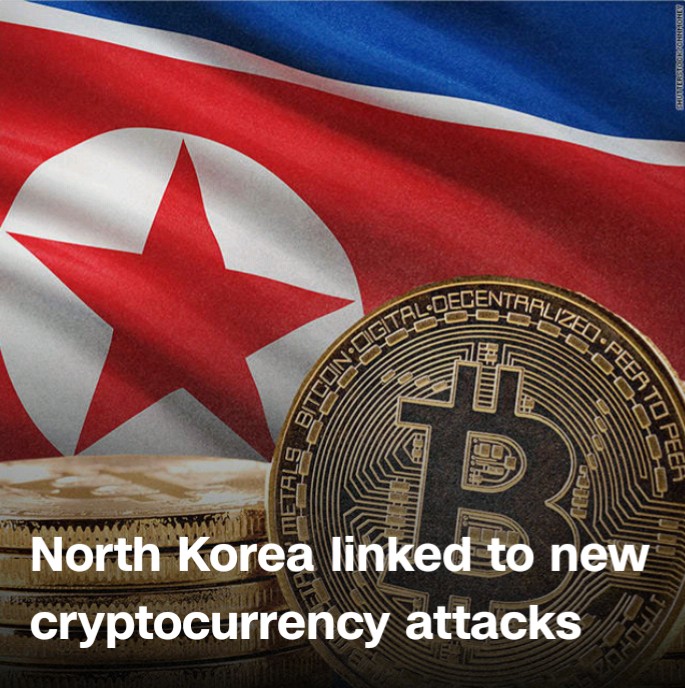
Hong Kong (CNNMoney) - North Korea-linked hackers targeted cryptocurrency investors and exchanges just as bitcoin started to soar to record highs, according to a new report.
Cybersecurity firm Recorded Future said malware used in the attacks was similar to that used in the Sony Pictures hack, the global WannaCry ransomware attack and the major cyberheist that hit Bangladesh's central bank.
Based on the malware, Recorded Future said it believes attacks late last year on South Korean cryptocurrency exchanges and their users were carried out by Lazarus, a hacking group that has previously been tied to North Korea.
Related: Bitcoin is too hot for criminals. They're using monero instead
The malware was created in mid-October and November, just as bitcoin began surging to jaw-dropping heights, according to the report, which was published Tuesday. Other cryptocurrencies like ethereum and monero have also experienced massive jumps in value in recent months.
"This late 2017 campaign is a continuation of North Korea's interest in cryptocurrency, which we now know encompasses a broad range of activities including mining, ransomware, and outright theft," Recorded Future researchers Juan Andres Guerrero-Saade and Priscilla Moriuchi wrote.
The report didn't say how successful the attacks, which included efforts to harvest cryptocurrency exchange users' passwords, might have been.
Related: South Korea may ban cryptocurrency trading
Many cryptocurrencies are designed to operate outside of the control of governments or banks. That's likely to appeal to North Korea at a time when the U.S. is stepping up efforts to cut the country out of the international financial system over its nuclear weapons program.
Previous reports from cybersecurity firms and South Korean government officials said North Korean hackers had targeted cryptocurrency exchanges in the summer of 2017.
Related: Bitcoin exchange goes bust after hack
North Korea has repeatedly denied involvement in international hacking attacks. But it has made no secret of its interest in bitcoin and other cryptocurrencies.
In November, the Pyongyang University of Science and Technology touted a lecture from a bitcoin expert who came to North Korea to teach students about the technology behind the digital currency. The university is a high-profile institution where scions of the North Korean elite study.
North Korea may be making a fortune from bitcoin mania
The revelations of the latest attacks on South Korean investors come as the country's government is considering whether to clamp down on cryptocurrency trading within its borders.
If the South Korean government tightens regulations and exchanges in the country step up security, North Korean hackers may "look to exchanges and users in other countries," the Recorded Future researchers said.
Financial Exclusion is limiting government's efforts to reduce poverty


Facts and figures from the United Nations show that 767 million people live below the international poverty line of $1.90 a day.
As long as financial exclusion remains high, everyone loses.
To comprehend the magnitude of the challenge we face in our quest to reduce poverty in Nigeria, we need to first acknowledge government’s efforts so far.
You will recall the establishment of social investment programs (SIP) initiatives which were aimed at reducing poverty and improving livelihoods of vulnerable groups such as the unemployed youths, women, and children.
The components of the SIP include:
N-Power: a job creation scheme supporting graduates and non-graduates. The scheme seeks to enhance the employability of participants by providing stipends while non-graduates acquire vocational skills. Graduates, on the other hand, are trained to work in communities as school teachers, health support, and agriculture extension workers.
Home Grown School Feeding (HGSF): a school feeding programme to enhance nutrition and learning of primary school children, markets for agriculture providers and jobs for food vendors in the community. Payments for agricultural produce and cooking services are made by the government.
iii. Conditional Cash Transfer (CCT): a poverty-reduction scheme providing cash transfers of N5,000 to one million very poor and vulnerable Nigerians on the national social registry (NSR).
Government Enterprise and Empowerment Programme (GEEP): an interest-free credit scheme for micro and small enterprises that lack access to formal credit.
These SIP schemes involve the disbursement of cash to a broad base of Nigerians and aim to increase the throughput of payments as well as promote financial inclusion. Large transaction throughput/volumes are essential in the enhancement of the DFS ecosystem and government’s SIP initiatives offer such an avenue to increase DFS transactions volumes.
Another fortunate development is that the Nigerian government was able to secure a $500 million loan from the World Banktowards the execution of this project. This throughput will facilitate monetary transaction flows between government and persons (G2P/P2G), government and business (G2B/B2G) and government and government (G2G).
Unfortunately, the SIP implementation has been hampered by extant financial system infrastructure constraints. In particular, these attempts by the government have exposed constraints in the areas of identity, reach (access) and cash-out (liquidity).
Let’s take the Conditional Cash Transfer (CCT) scheme, for example.
During its initial phase, the scheme covered 9 States with existing social registries. Potential beneficiaries in the national social registry were validated using the bank verification number (BVN) scheme. After validation, funds were paid through the Nigerian Interbank Settlement System (NIBBS) into bank accounts in participating banks. Since the scheme launched in 2016, three challenges - identity, reach and cash-out - have limited CCT scalability and the intended social and economic benefits.
Identity
Firstly, due to technical and operational constraints with the BVN system, only about 20 percent of the NSR beneficiaries have been validated.
The requisite process of validating the identities of intended CCT beneficiaries and account creation has not produced sufficient recipients of the CCT funds. The technical and operational constraints of the BVN scheme such as the use of proprietary technology and their ancillary costs, data quality and accuracy have all limited the establishment of enrolment centres to an already limited number of bank branches.
Reach
Secondly, the lack of proximity to, and availability of, financial service points (FSPs) — bank branches and/or agents which are meant to provide account opening and other customer service activities at the last mile - renders CCT funds which are domiciled in bank accounts inaccessible. In the case of account opening, only about 57 percent of beneficiaries with validated BVNs have successfully opened bank accounts.
A 2015 study of financial service points (FSPs) in Nigeria revealed that there were less than 30,000 access points serving an adult population more than 90 million. The table below showing access point by distance further emphasises the plight of rural dwellers.

The proximity of access points presents a conundrum that impacts consumer utility, commercial sustainability of agents and ultimately financial inclusion. Resolving this challenge mandates the creation of additional access points and systematic mechanisms that facilitate commercial sustainability through even demand for agent services and increased transaction volumes.
Cash-Out
Thirdly, FSP liquidity for on-demand cash payouts (cash-out) cannot be met as and when due.
The conversion of digital payments to physical cash at agent locations is often limited by the proximity/access problem and manifests in user behaviours that warrant the immediate and complete withdrawal of funds received, leaving no residual funds in the account. This behaviour is not only detrimental to cashless tenets but also creates a surge in liquidity demand at peak periods that may be difficult to fulfill (thereby leading to service fee hikes and exploitation).
Unattended management of such service failures could potentially jeopardise trust and confidence in the financial services system.
In sum, addressing these pain points, which are mostly operational and exploratory, will ultimately improve financial inclusion and also address the scalability of the CCT and other SIP schemes. Without definitive knowledge of the implementation outcomes of the proposed initiatives, a regulatory approach that supports experimentation and testing is essential. Hence why we suggested the introduction of regulatory sandboxes for financial services in an earlier article.
Olayinka David-West and Ibukun Taiwo are members of the Sustainable and Inclusive Digital Financial Services Initiative at Lagos Business School
Bitcoin Crash: CBN Cautions In Virtual Currencies Trading Stands

Leadership Nigeria Newspapers BUSINESSBitcoin Crash: CBN Cautions In Virtual Currencies Trading StandsPublished 27 mins ago on January 8, 2018 By KAYODE TOKEDE In January 2017, the Central Bank of Nigeria (CBN) warned Nigerians and financial institutions to stay away from virtual currencies that have attracted investment in payments infrastructure that provides new methods for transmitting value over the internet. The CBN had reiterated that virtual currencies such as Bitcoin, Ripples, Monero, Litecoin, Degecoin, OneCoin among similar products are not legal lenders in Nigeria, thus any financial institution that transacts in such businesses does so at its own risk. As at the time of writing this report, bitcoin, a world known cryptocurrency, has continued to crash as investors globally are getting their fingers burnt. After the bitcoin craze rose to a near-fever pitch in 2017, several investors and analysts this year are predicting more growing pains for cryptocurrencies over surge in speculations and governments placing ban. Interestedly, as bitcoin price has stagnated in the last two weeks, smaller digital currencies such as Ripple, Stellar and Tron have surged into the ranks of the largest cryptocurrencies by market capitalization. Bitcoin saw its highest value before the Christmas holidays when it reached the staggering price of just below $20,000 but valued at $14,815.88 as at last week, according to CoinDesk. Checks by LEADERSHIP revealed that one bitcoin equals an estimated N6 million as at January 5, 2018 as more Nigerian youths on MMM are taking interest in investing in virtual currencies, bitcoin specifically. Financial experts have joined regulating bodies to discourage investors to buy and trade with bitcoin due to its incredible volatility. Most of them are of the opinion it is a bubble ready to burst this year. They expressed that as governments tighten their grip, bitcoin prices will most likely fall, and perhaps collapse, though the timing is impossible to judge. Bitcoin seems too prone to illicit use and too vulnerable to government regulation to survive for the long term. They hinted that, “contrary to the attestation of its proponents, bitcoin contains several flaws that foretell its eventual doom. “The crux of his argument is that once central banks begin to view bitcoin as a credible threat, governments will declare war on cryptocurrency and suppress it out of existence through hostile regulatory policies.” One of the most highly-regarded economists in the US said that he believes the bitcoin price is in a bubble and will “likely burst” over the long-term, even if it continues to appreciate in the short-term. Last year, Nigeria key market regulating bodies, CBN, Securities and Exchange Commission (SEC) and Nigeria Deposit Insurance Corporation (NDIC) were increasingly vocal in warning investors about the risks of cryptocurrencies.
Leadership Nigeria Newspapers BUSINESSBitcoin Crash: CBN Cautions In Virtual Currencies Trading StandsPublished 27 mins ago on January 8, 2018 By KAYODE TOKEDE In January 2017, the Central Bank of Nigeria (CBN) warned Nigerians and financial institutions to stay away from virtual currencies that have attracted investment in payments infrastructure that provides new methods for transmitting value over the internet. The CBN had reiterated that virtual currencies such as Bitcoin, Ripples, Monero, Litecoin, Degecoin, OneCoin among similar products are not legal lenders in Nigeria, thus any financial institution that transacts in such businesses does so at its own risk. As at the time of writing this report, bitcoin, a world known cryptocurrency, has continued to crash as investors globally are getting their fingers burnt. After the bitcoin craze rose to a near-fever pitch in 2017, several investors and analysts this year are predicting more growing pains for cryptocurrencies over surge in speculations and governments placing ban. Interestedly, as bitcoin price has stagnated in the last two weeks, smaller digital currencies such as Ripple, Stellar and Tron have surged into the ranks of the largest cryptocurrencies by market capitalization. Bitcoin saw its highest value before the Christmas holidays when it reached the staggering price of just below $20,000 but valued at $14,815.88 as at last week, according to CoinDesk. Checks by LEADERSHIP revealed that one bitcoin equals an estimated N6 million as at January 5, 2018 as more Nigerian youths on MMM are taking interest in investing in virtual currencies, bitcoin specifically. Financial experts have joined regulating bodies to discourage investors to buy and trade with bitcoin due to its incredible volatility. Most of them are of the opinion it is a bubble ready to burst this year. They expressed that as governments tighten their grip, bitcoin prices will most likely fall, and perhaps collapse, though the timing is impossible to judge. Bitcoin seems too prone to illicit use and too vulnerable to government regulation to survive for the long term. They hinted that, “contrary to the attestation of its proponents, bitcoin contains several flaws that foretell its eventual doom. “The crux of his argument is that once central banks begin to view bitcoin as a credible threat, governments will declare war on cryptocurrency and suppress it out of existence through hostile regulatory policies.” One of the most highly-regarded economists in the US said that he believes the bitcoin price is in a bubble and will “likely burst” over the long-term, even if it continues to appreciate in the short-term. Last year, Nigeria key market regulating bodies, CBN, Securities and Exchange Commission (SEC) and Nigeria Deposit Insurance Corporation (NDIC) were increasingly vocal in warning investors about the risks of cryptocurrencies. For instance, the CBN said virtual currencies are largely used in terrorism financing and money laundering, considering the anonymity of virtual transactions. The director, financial policy and regulation department, CBN, Mr. Kevin Amugo in a signed document said, transactions in virtual currency are largely untraceable and anonymous making them susceptible to abuse by criminals, especially in money laundering and financing of terrorism. “Virtual currencies are traded in exchange platforms that are unregulated, all over the world. Consumers may there lose their money without any legal redress in the event these exchangers collapse or close businesses. The attention of bank and other financial institutions is hereby drawn to the above risks and you are required to take the following actions pending substantive regulation or decision by the CBN,” the statement read. According to him, actions that needs to be taken by financial institutions include: “ensure that you do not use, hold, trade and/or transact in any way in virtual currencies. Ensure that existing customers that are virtual currency exchangers have effective capital AML/CFT controls that enable them to comply with customer identification, verification and transfer, monitoring requirements.
Naira to hit 360/dollar at investors’ forex market

Dirty naira notes flood Nigerian markets •Customers, CBN blame banks

Irked by the increasing amount of dirty, mutilated naira notes in circulation, the banking public in Lagos and its environs are blaming commercial banks and calling on the Central Bank of Nigeria (CBN) to control the situation.
This they said, have been causing a lot of arguments, embarrassment, and loss of sales for commercial transport drivers, petty traders, and their customers among others.
But in a swift reaction, the CBN, through the Acting Director of Corporate Communications, Mr. Isaac Okoroafor said commercial banks are responsible for this because they deliberately flood the system with such notes.
A bank customer and lawyer who preferred anonymity is seriously worried that the alarming quantity of dirty/mutilated currency notes in circulation had become a national embarrassment.
He added that banks were issuing torn, mutilated and unhygienic currency notes through Automated Teller Machines (ATM), and across the counter.
Specifically, he said, “I observe that in spite of arrest and subsequent prosecution of the culprits, there is still a cartel in CBN and commercial banks, which make brisk business recycling old naira notes meant for destruction.
They enrich their bank accounts according to him, acquiring properties through these illegal proceeds by converting the equivalent of the mutilated notes into their accounts and selling printed mint, meant for customers, to touts and hawkers.
“Section 21(4) of the CBN Act of 2007 makes it a punishable offence for any person to hawk, sell or trade in naira notes, coins or any other issued by the apex bank,” he said.
The legal practitioner stressed that most of the mutilated currency notes in circulation harboured pathogenic microorganisms hazardous to human health. He said that the mutilated notes also harboured infectious diseases such as diarrhea, food poisoning and respiratory problems which could be spread through the notes
Another customer with one of the new generation banks, Mr Jude Okon told Nigerian Tribune that the bulk of naira notes in circulation look so bad. According to him, it is, even so, worse that “when they are given to you as balance (change), you prefer to reject them because spending such notes is a herculean task.”
Okon said most of the bad notes are already turn into unrecognizable pieces and the amount CBN charges commercial banks is too small to warrant such national embarrassment. His words: “Some of them can compare to papers fit for dustbin or pit toilets. The fact that they are still been exchanged as legal tender, marvels not a few Nigerians. In fact, they look to me as a ready source of transmitting diseases.”
While calling on the central bank to find ways of taking them off circulation, Okon said the shocking thing he discovered is that commercial bank’s tellers are using “cello tape” to fix some of the bad naira notes.
“Do you know what? I apply cello tape every now and then and just last Sunday, I still did it for a naira note that was so bad. CBN should simply do something about the problem; it is simply making a bad statement about us as a country,” he lamented.
Responding to the above, Okoroafor said, all over the world, it is the duty of commercial banks to sort dirty and mutilated notes and return them to the central bank.
In the same way, “as a good bank customer, when you want to deposit money in the bank, you sort the good ones out and the ones that are bad. That is what the banks are expected to do when they have unfit notes that should be brought to CBN but they fail to do it.
According to Okoroafor, the banks are supposed to employ people to do the sorting, the same way CBN has employed people to do it. Instead, they expect the CBN to do the sorting because they are avoiding the cost.
“So, instead of bringing them to us sorted, the banks bring them unsorted. Then we started charging them N12, 000 per box. A box of N1000 notes contains N10million worth. So, a box of N500 notes is N5 million in that order. So, in a bid to avoid cost, they preferred to re-circulate old and mutilated notes.”
Okoroafor had earlier given other reasons why there are so many mutilated Naira notes in circulation.
According to him, people handle these notes so badly and so within a short while they don’t get to their lifespan anymore and for the lower denomination notes, they have a higher velocity of circulation.
“What that means is that you use it more often and as you use it in exchange, it gets worn out and gets torn more frequently. So, that also creates another problem.
However, based on the above explanation, the House of Representatives had earlier this year, directed the Central Bank of Nigeria to stop imposing charges on commercial banks before receiving mutilated and dirty notes from them.
The House noted in Abuja that the surcharge was one of the major reasons why the banks were reluctant to withdraw such notes from circulation or accept them from customers.
He promised that the CBN apart from monitoring and sanctioning those caught, violating extant rules is working with appropriate authorities to arrest the ugly situation.
An accountant with one of the print media organisations complained that some banks are rejecting the mutilated notes even when the numbers and every other information on the naira notes are still visible.
According to her, “each time I take money to the bank, they will collect the good notes and reject the sorted, mutilated ones. They will tell me that I should take it to First Bank where it will be accepted. I have experienced this with a particular branch of United Bank for Africa and Wema Bank.”
An analyst, Kirk Leigh regretted that when old worn-out notes are being surreptitiously channelled back into the system, there are no records of the ‘transactions’ and the immediate implication is that the Central Bank has an inaccurate, amount of currency in circulation and therefore has no control of aspects of monetary policy couched on fractional banking and interest rates.
“It makes nonsense of the money multiplier and the Monetary Policy Rate (MPR), instruments for managing money in circulation, volume of credit and inflation. This could mean that the quarterly meeting of the Monetary Policy Committee (MPC) of the Central Bank is a mere hang out of peers, a charade with little or no impact on the economy,” he said in an article on Thursday.
World's largest amphibious aircraft takes off in China


The plane, codenamed "Kunlong" according to state news agency Xinhua, took off from the southern city of Zhuhai and landed after roughly an hour-long flight.
With a wingspan of 38.8 metres (127 feet) and powered by four turboprop engines, the aircraft is capable of carrying 50 people and can stay airborne for 12 hours.
"Its successful maiden flight makes China among the world's few countries capable of developing a large amphibious aircraft," chief designer Huang Lingcai told Xinhua.
The amphibious aircraft has military applications but will be used for firefighting and marine rescue, with at least 17 orders placed so far with state-owned manufacturer Aviation Industry Corp of China, state media reported.
While it is around the size of a Boeing 737, the AG600 is considerably smaller than billionaire Howard Hughes' flying boat, better known as the Spruce Goose, which had a wingspan of 97 metres and a length of 67 metres but only made one brief flight, in 1947.
The AG600's flight capabilities put all of China's island-building projects in the South China Sea well within range.
"Its 4,500-km operational range and ability to land and take off from water makes it well-suited for deployment over China's artificial islands," said James Char, a military analyst at Singapore's Nanyang Technological University.
The aircraft can fly to the southernmost edge of China's territorial claims -- the James Shoal -- in just four hours from the southern city of Sanya, state-owned Global Times reported.
The shoal is also claimed by Taiwan and Malaysia, and is currently administered by Malaysia. The collection of submerged rocks lies roughly 80 kilometres from Malaysia's coastline and about 1,800 kilometres from the Chinese mainland.
"The plane's capacity and maneuverability makes it ideal for transporting materiel to those maritime features that are too structurally fragile to support runways," Char said.
Beijing's buildup in the South China Sea, through which some $5 trillion in annual trade passes, is hotly contested by other nations.
The Philippines for many years was one of the region's strongest opponents of Chinese expansionism, and brought a complaint to a United Nations-backed tribunal.
The panel ruled last year that China's territorial claims in the sea were without legal basis, but the Philippines has backed away from the dispute under its new president Rodrigo Duterte.
The launch of the new amphibious aircraft further strengthens China's rapidly modernising military.
Earlier this year, it launched its first domestically built aircraft carrier, the Type 001A. This complemented the Liaoning, a second-hand Soviet carrier commissioned in 2012 after extensive refits.
China's military expenditure in 2016 was an estimated $215 billion, according to the Stockholm International Peace Research Institute, putting it in first place in Asia, well ahead of India ($56 billion), Japan ($46 billion) and South Korea ($37 billion).
Bitcoin exchange goes bust after hack
By Daniel Shane
A bitcoin exchange in South Korea has gone out of business after being hacked, highlighting the perils of trying to cash in on this year's stunning boom in digital currencies.
Seoul-based Youbit said it was filing for bankruptcy after cyber-thieves stole nearly a fifth of its clients' holdings in an attack Tuesday.
It's the second time this year that Youbit, which allows customers to trade bitcoin and other digital currencies, has been hit by hackers.
In April, thieves made off with 38 billion won ($35 million) in digital currencies. The company didn't say how much was taken in the latest heist or how exactly it happened.
Related: What is bitcoin?
South Korea's Korea Internet and Security Agency said Wednesday that it was working with police to investigate this week's Youbit hack, but that it didn't yet know who was responsible.
Youbit said that its customers would get back about three-quarters of the value of the digital currencies they had stored in accounts with the exchange. The rest will be refunded after bankruptcy proceedings, it said.
Bitcoin's history is littered with cases of trading platforms coming under attack.
Earlier this month, hackers stole more than $70 million worth of bitcoins from digital currency platform Nicehash. Last year, Hong Kong-based exchange Bitfinex was briefly shut down after hackers stole more than $60 million in bitcoins.
Related: More than $70 million stolen in bitcoin hack
Tim Wellsmore, director of threat intelligence at cybersecurity firm FireEye, said bitcoin exchanges had been slow to respond to the threats posed by hackers.
"As the prices of bitcoin and similar virtual currencies continue to appreciate, we expect greater interest from attackers seeking to steal it," he said.
Bitcoin's price is now more than 15 times as high as it was at the start of the year.
Suspicion for this week's Youbit hack could fall on North Korea.
South Korean police have accused North Korean hackers of targeting at least four different exchanges this year that trade bitcoin and other digital currencies in South Korea.
North Korea has previously denied any role in international cyberattacks.
Related: North Korea may be making a fortune from bitcoin mania
Bitcoin, which offers layers of anonymity, has long been a magnet for criminals.
Unlike traditional currencies like the U.S. dollar, digital currencies don't fall under central bank control and are largely unregulated.
South Korea has become a hotbed of bitcoin activity. On a given day, the country can account for about 20% of worldwide trading in the cryptocurrency.
Bitcoin is in such high demand there that traders can end up paying a premium of between 15% and 20% compared with prices elsewhere.
Related: Bitcoin futures trading just got a lot bigger
Youbit was a small player in the market, which is dominated by Bithumb, a much larger exchange.
With so many small South Korean investors diving into bitcoin, authorities are getting worried about the potential impact of a crash.
The government earlier this month said it was forming a special task force to study the "cryptocurrency problem."
-- Jake Kwon and Hannah Kang contributed to this article .
Seven money-saving apps to help you eliminate debt

Dollar, stocks drop in Asia as Fed fails to inspire


The fall in the greenback was mirrored in a broad sell-off in regional equities as traders ignored another record finish for the Dow on Wall Street.
The dollar was hit by selling after the much-anticipated central bank meeting, which provided little to excite buyers, despite tentative hopes US lawmakers are on course to push through market-friendly tax cuts.
The Fed lifted borrowing costs as expected and said economic growth would be stronger than initially forecast, while inflation would also improve. It also said its projections for three more rate rises next year were on course.
However, Marvin Loh, senior global market strategist at Bank of New York Mellon, told Bloomberg News: "Markets are generally interpreting the meeting as a dovish hike.
"The improved view in 2018 may be driven by tax reform, which will not have a long-lasting impact."
A below-par reading on inflation added to selling in the dollar, which retreated against most other currencies in New York. It fell through the 113 yen mark, while the pound was above $1.34 and the euro broke $1.18.
And in Asia it continued to struggle, while the Australian dollar surged 1.4 percent, supported by a better-than-expected jobs reading from Canberra. There were also healthy gains for the South Korean won, South African rand and Mexican peso.
The yuan rose 0.1 percent, with some help from news that People's Bank of China had lifted the interest rates it charges lenders. It similarly followed a Fed hike in March in a bid to prevent cash from flowing out of the country to chase better investment returns.
Greg McKenna, chief market strategist at AxiTrader, said the weakness in the dollar "suggests (investors) don't believe the Fed's outlook nor its rate projections".
- Tax-cut hopes -
Adding to nervousness among traders was the Republicans' shock loss in the Alabama senate election, which narrowed their majority to just two -- fuelling concern that Donald Trump will struggle to push through many of his promised reforms.
However, there is hope his much-vaunted tax cuts will be passed before the Democrats' newest senator takes his seat.
Reports said Wednesday that Republicans in both chambers of Congress had reached an agreement in principle on the massive tax bill, setting the stage for its final passage next week.
On equity markets Tokyo ended 0.3 percent lower as exporters were weighed by a stronger yen, while Shanghai dipped 0.3 percent and Singapore fell 0.8 percent.
Hong Kong gave up 0.2 percent, Sydney eased 0.2 percent and Seoul dropped 0.5 percent.
However, Taipei, Manila and Wellington were all in positive territory.
Oil prices edged up but only made a small dent in Wednesday's losses, which came despite another report showing US inventories had fallen.
"That suggests a lot of, perhaps all, the current news about tightness in the oil market is already priced," said McKenna.
There are also worries that an output cap agreed by major producers in OPEC and Russia could be lifted next year.
In early European trade London fell 0.2 percent, while Paris and Frankfurt each lost 0.1 percent.
- Key figures around 0820 GMT -
Tokyo - Nikkei 225: DOWN 0.3 percent at 22,694.45 (close)
Hong Kong - Hang Seng: DOWN 0.2 percent at 29,166.38 (close)
Shanghai - Composite: DOWN 0.3 percent at 3,292.44 (close)
London - FTSE 100: DOWN 0.2 percent at 7,482.16
Euro/dollar: UP at $1.1832 from $1.1828 at 2200 GMT
Pound/dollar: UP at $1.3430 from $1.3415
Dollar/yen: UP at 112.67 yen from 112.56 yen
Oil - West Texas Intermediate: UP 14 cents at $56.74 per barrel
Oil - Brent North Sea: UP 41 cents at $62.85 per barrel
New York - DOW: UP 0.3 percent at 24,585.43 (close)
Alabama Senate election: Inside story of the GOP meltdown

By Rebecca Berg, CNN
Dec 14, 2017
(CNN) - Mitch McConnell was worried about Alabama.
Republican Sen. Jeff Sessions was now President Donald Trump's attorney general, opening up a Senate seat McConnell would need to focus on in November 2018.
Early this year, he started seeing reports in local Alabama press that gave him pause, someone close to the senator told CNN. The Alabama governor was considering holding a special election this year, rather than next. Should he be concerned about a possible date change that could add new pressure on the party? Sen. Luther Strange, appointed to replace Sessions, said not to be.
Had that conversation gone differently, McConnell might have sought to persuade Gov. Kay Ivey to keep the 2018 election date. He might have called upon the White House to intervene. Instead, Washington Republicans were caught flat-footed when Ivey announced in April that she would schedule the special election early, for this year.
The decision was the first in a series of unimaginable missteps and miscalculations that led to one of the biggest Republican political disasters in recent years, culminating in Republican Roy Moore's defeat Tuesday to Democrat Doug Jones. The result marked the first time in more than two decades that a Democrat had won a Senate seat in deep-red Alabama.
"The remarkable thing is, it's one big, gigantic self-inflicted wound," said Josh Holmes, McConnell's former chief of staff and campaign manager. "The election itself did not need to happen."
From that first fateful decision until Tuesday, the race unfolded for the Republican Party as a political case study in Murphy's Law: whatever could go wrong, did.
And GOP strategists now fear the party could remain stuck in the morass into 2018 and beyond, symbolically linked to Moore even as they try to put his loss behind them.
The race will be remembered as much for Moore as for the test he posed to Washington Republicans, and the divisions he exposed among them, especially between McConnell and the White House.
This is the story of how the Alabama Senate race unfurled and ultimately unraveled, as told to CNN in conversations with nearly a dozen people aligned with the Trump administration, Senate Republicans and the political wing of Steve Bannon, the President's former chief strategist who bucked the party and backed Moore.
A White House divided
Judge Roy Moore was no national Republican's first choice. During the first round of the Republican primary, influential conservatives coalesced behind Rep. Mo Brooks, while McConnell and the National Republican Senatorial Committee favored Strange.
But the President's team was on the fence. Some White House advisers strongly favored endorsing Strange, including Rick Dearborn and the legislative affairs team, Trump's son-in-law Jared Kushner, and the vice president's advisers, according to multiple sources inside and outside of the administration. They argued that Strange had been loyal to the President and would be a key vote on major legislation like tax reform.
Dearborn, a former chief of staff to Sessions, also maintained deep Alabama connections. His wife, a GOP strategist in the state, is staunchly anti-Moore.
The President's political office, however, which at the time included Bannon, cautioned against intervening in the primary, fearing the move would carry unnecessary political risk and, possibly, provoke a backlash among Trump's core supporters.
"To me, getting behind Luther was inconsistent with who we are and how we got here," said one source familiar with the internal discussions.
In the end, one administration official said, there wasn't extensive debate or hand-wringing.
"The President ultimately wanted to do the right thing" and endorse Strange, the official said, "because Luther had been with him on every vote without even asking."
If Strange's loyalty to Trump was a selling point, however, he was weighed down politically by his initial appointment to the Senate by Gov. Robert Bentley, who afterward left office under the cloud of a sex scandal involving a top aide. Plus, Brooks and then Moore sought to frame Strange as a creature of the Republican establishment -- at a moment when that label was toxic in Alabama.
Meanwhile, efforts by national Republicans to help Strange were backfiring. The McConnell-aligned Senate Leadership Fund spent tens of millions of dollars to boost him -- furthering attacks by Strange's rivals that he was bought and paid for by Washington Republicans.
Bannon sees an opportunity
When Bannon departed the White House in August, he and his allies saw McConnell's investment in the race as an opportunity to score points for his own populist-nationalist movement by waging a proxy fight against the Senate leader.
"I was with Steve at his dining room table, and he looked at me and said, 'Surabian, we've got to do this,'" recalled Andy Surabian, Bannon's former deputy in the White House, now a senior adviser to the pro-Trump Great America PAC. "If it wasn't for Mitch McConnell, there's a good chance Steve Bannon would have never gotten involved in this race at all."
With the President still backing Strange, Bannon threw his support to Moore -- ensuring that some of his allies would follow. By the end of September, just before Election Day, they had organized dual rallies in support of Moore: Sebastian Gorka and Sarah Palin appeared at one in Montgomery, and Nigel Farage, Duck Dynasty's Phil Robertson and Bannon headlined another in Fairhope.
"That was a shot across the bow to not only the President, but also Bannon's detractors, including Matt Drudge, who claimed if Steve was fired he would not have any influence," said Sam Nunberg, a former Trump campaign aide who is in Bannon's circle. "There's more power on the outside."
A few days earlier, the President had traveled to Alabama for a rally of his own -- a decision he reached as a result of a meeting with Sen. Bob Corker, in which the President indicated to Corker that he believed Strange would win. Corker warned Trump that the race was not going as smoothly as he thought.
To settle the debate, "they got some consultants on the phone," including former National Republican Senatorial Committee Executive Director Ward Baker, "and confirmed what Corker was saying," said a source briefed on the conversation. "At the end of the conversation, (Trump) committed to go to Alabama."
But by the time the President stood on stage in Huntsville on September 22, even as he heaped praise on Strange, Trump also seemed uncertain about his decision.
"I'll be honest, I might have made a mistake," Trump said.
Washington meets Roy Moore
The morning after the runoff election when Moore defeated Strange, McConnell called Moore to congratulate the new Republican nominee. The conversation lasted just a minute, said one source familiar with the call, and Moore said little.
But his victory spoke volumes -- and Republicans in Washington were getting the message.
Bannon hailed the victory as the start of a "revolution." The President expressed his support for Moore, and deleted some of his earlier tweets supporting Strange. In early October, Moore made the rounds in Washington, meeting with lawmakers including Sen. Cory Gardner of Colorado, the NRSC chairman.
As Trump and Republican groups lined up behind Moore for the general election, however, few believed they would need to actively support him. There was little doubt he would be the next senator from Alabama. And one month later, the race seemed to be progressing as expected.
The Story
After the GOP runoff, Brian O. Walsh, president of the pro-Trump super PAC America First Action, said he had put a note on his calendar to poll the race November 9. That morning, he called the group's pollsters -- and, a few hours later, he urgently called them back. They would need to rethink their questions.
A Washington Post story had just published, featuring four women who alleged Moore had pursued sexual relations with them when they were teenagers, including one who said she was just 14 years old at the time.
Among Republicans in Washington, "there was a lot of shock, a lot of awe, a lot of confusion as to how nobody discovered it before that day," said one party strategist familiar with the Senate race. "Everyone just sighed and said, 'Well, here we are.'"
As the Republican National Committee and the NRSC cut ties with Moore's campaign, McConnell and other Republicans called for Moore to step aside. Behind the scenes, party operatives assessed possible scenarios: they could attempt to circumvent Moore with a write-in candidate, persuade Ivey to delay the election, or run Moore out of the race altogether.
Although McConnell would in the following days float Sessions as a potential write-in ringer, that idea quickly fizzled.
"Short of (University of Alabama football coach) Nick Saban or Jesus Christ, you were going to have a really tough time," said the Senate Republican campaign official. "So it kind of took the write-in off the table."
Strategists in McConnell's orbit soon landed on an obscure legal precedent, which suggested that Ivey could call a new special election if Strange stepped down and another replacement was appointed, the official said. Sen. Richard Shelby and Vice President Mike Pence, in addition to the vice president's staff, were in communication with Ivey — but the governor wouldn't budge.
Meanwhile, McConnell's allies pitched the White House on the plan, "and initially they were interested," said a Senate campaign official.
But, internally, the President's political shop worried that such a Hail Mary would be "the kind of scheme that voters in Alabama would see right through," according to two sources familiar with their discussions.
"None of it was realistic," said an administration official.
Moore rebounds
Crucially, as Republicans processed and sought to work through the crisis, the President was out of the country completing an extended swing through Asia -- leaving a vacuum at home, with no clear guidance to his allies.
Meanwhile, the talk among Republicans of ousting Moore was energizing Bannon and his network anew. In one internal discussion, "we all agreed that McConnell was trying to kill two birds with one stone and take down Steve with Moore, and we weren't going to let that happen," said Nunberg.
But Bannon first needed to bring some of his influential allies onto the same page.
On November 14, Fox News anchor Sean Hannity stunned some conservatives when he delivered an ultimatum to Moore: "remove any doubt" about the allegations against him, or "get out of this race." Hannity's bold and unexpected stand drew a phone call from Bannon, who urged Hannity to tone down his rhetoric and let Alabama voters decide, a source told CNN at the time. The following evening, Hannity softened his tone, saying the issue "shouldn't be decided by me."
There were still other fires to extinguish. That same week, in an interview with the Associated Press, Ivanka Trump said of Moore: "There's a special place in hell for people who prey on children. I've yet to see a valid explanation and I have no reason to doubt the victims' accounts." The statement would be featured prominently on mailers and in television ads against Moore.
Through intermediaries and directly, Bannon and his network warned the White House that the President could anger his political base were he to call for Moore to step aside, multiple sources familiar with those discussions said. Bannon remained in semi-regular contact with Trump by phone.
Franken changes the landscape
An unrelated event soon convinced some Republicans that the landscape was shifting. On the morning of Nov. 16, as the White House political team met, news was breaking of a woman accusing Sen. Al Franken of sexual misconduct.
Watching the story unfold, White House political director Bill Stepien predicted a pivot point, telling his colleagues, "This changes the conversation, and this will dramatically change public opinion and open the door for Moore," according to sources who were present.
"The light bulb went on for everyone," recalled one official who was in the meeting. Suddenly, the public discussion of sexual misconduct was bipartisan.
Trump's endorsement and rally
Following the Thanksgiving holiday, Trump marked a new phase of the campaign as he began to hint at an endorsement of Moore, attacking Jones in a public statement on Twitter.
Trump "(knew) that this is not a sure thing," said a source familiar with the President's endorsement. "He was willing to put his own political capital on the line."
A few days later, Bannon announced to CNN that he would return to Alabama for a rally December 5 to kick off the final week of the campaign, saying he "(looked) forward to standing with Judge Moore and all of the Alabama deplorables in the fight to elect him to the United States Senate and send shockwaves to the political and media elites."
It had become clear that Moore would not be challenged by a last-minute write-in candidate or persuaded to leave the race, and some Senate Republicans grew quieter. On December 3, McConnell said on ABC's "This Week" that he would "let the people of Alabama make the call" on Moore.
McConnell's circle insisted he was not softening his previous stance on Moore, so much as "(acknowledging) that despite our best efforts, Moore will be on the ballot," said one source familiar with McConnell's thinking.
The next day, Trump explicitly endorsed Moore and later called him from Air Force One en route to Utah, saying, "Go get 'em, Roy!"
Groups aligned with the President, including the Republican National Committee and America First Action, followed his lead, announcing they would spend money on the race. Walsh said the decision by America First was a "clinical" one, informed by data on the race, the President's posture, and the legislative implications.
"You can't simply write off a US Senate seat," Walsh said.
But the President's endorsement violently ruptured the GOP, with McConnell's wing of the party standing on the other side of the chasm. The NRSC and SLF announced they would not re-engage in the race.
Following Trump's decision to endorse Moore, the President on one occasion attempted to speak about the race with McConnell, said a Senate campaign official familiar with the conversation. "And McConnell indicated they're going to have to agree to disagree on that issue, and they should talk about other issues instead," the official said.
'You can lose basically everywhere'
The reckoning is likely just beginning.
With Moore's defeat, the President suffers one more political bruising that could cause Republicans to question his broader political strategy moving into 2018.
McConnell could be pressed by donors and party loyalists to defend his decisionmaking that resulted in the party losing a crucial Senate seat.
And Bannon's allies have promised to continue taking on McConnell into the midterm elections. "The war inside the Republican Party is only going to get more vicious and more bloody," said a source familiar with Bannon's plans.
Ultimately, however, all three camps will be forced to grapple with a historic failure in the race for an impossibly safe Senate seat.
"If you can figure out how to screw up a state as red as Alabama," Holmes said, "you can lose basically anywhere."
Forex market gets another $210m boost from CBN

According to figures obtained from the Bank, Tuesday’s interventions were for the Wholesale, Small and Medium Enterprises (SMEs) and invisibles segments of the market.
Acting Director, Corporate Communications at the CBN, Mr. Isaac Okorafor disclosed that the Bank offered the sum of $100million to the wholesale segment, while the SMEs and invisibles segments each received the sum of $55 million.
He reiterated that the releases were meant to boost liquidity, trade, and ease of remittances for legitimate personal commitments.
In spite of the stable rate of N360/$1 and the expected inflow from various sources such as the Eurobond and remittances from the Diaspora, Okorafor said the Bank would continue to intervene in the inter-bank forex market to guarantee liquidity.
While also noting that the interventions had largely checked unwholesome activities of currency speculators, he said that the CBN would not relent in its daily monitoring of activities in the market in order to ensure that all concerned operate in line with extant rules.
Meanwhile, the naira maintained its steady rate against major currencies around the globe, exchanging for N360/$1 in the BDC segment of the market on Tuesday, December 12, 2017.
Oil price jumps above $65

65.07 dollars a barrel at 0211 GMT.
Naira depreciates to N360.5 in I&E

Data from the Financial Market Dealers Quote (FMDQ) showed that indicative exchange rate for the I & E window, known as Nigerian Autonomous Foreign Exchange, NAFEX, rose to N360.50 per dollar,Monday, from N360.41 per dollar last week.
Meanwhile, the volume of dollars traded fell by 54 percent to $96.77 million yesterday to $209.05 million Friday last week.
The naira however remained stable at N363 per dollar in the parallel market for the sixth consecutive business day.
Popular Posts
-
 The Nigerian Navy Direct Short Service Commission (DSSC) 25 Course has released list of its successful candidates who passed the Aptitude...
 -
 Outrage over six dead appointees on Buhari’s board list Niyi Odebode, John Alechenu, Olalekan Adetayo, Adelani Adepegba, Ade Adesomoju,...
 -
This file photo taken on August 31, 2006 shows a permanent memorial to Diana, Princess of Wales and Dodi al-Fayed is seen in Harrods ...
-
 Coalition holds #EndSARS rallies nationwide today A coalition of civil society groups will on Monday (today) hold rallies nationw...
 -
 Ex-Ivorian Star Emmanuel Eboue Is Dead The former Ivorian International star, Emmanuel Eboue, is dead. Emmanuel Eboue is reported to ha...

Popular Posts
-
 WAEC Extends Private Candidates Registration Till January The West African Examination Council (WAEC) has extended the closing date f...
 -
 Scientists have warned that the more Viagra-type drugs men take, the lower their sexual confidence becomes. This warning was contained ...
 -
 SEOUL, South Korea – The Latest on tensions over North Korea's nuclear and missile programs (all times local): 9 p.m. NATO's...
 -
Russian Foreign Minister Sergei Lavrov has accused the US of seeking to provoke North Korea into stepping up its nuclear missile program...
-
The ‘fraud’ called new year resolution “SUCCESS isn’t owned; it’s leased, and the rent is due every day”-J. J. WattPaula White once sa...


