
PDP holds solidarity rally for Saraki in Kwara

The party members marched through all the streets in Kaiama, the Headquarters of the local council.
The News Agency of Nigeria (NAN) reports that the rally came up a day after Saraki declared his intention to contest 2019 presidential election on the platform of PDP.
All political office holders from the area at both the state and local government levels participated in the rally that lasted for hours.
Mallam Abubakar Abdullahi-Bata, the Chairman of Kaiama Local Government Council said that the rally was staged to express the support of the people of the area to the leadership of Saraki.
According to him, the large turnout has corrected an insinuation that PDP is dead in the community.
“The people of Kaiama are for Saraki because we believe in his leadership.
“We are ready to follow him to any party he wishes to lead us to because we have benefited immensely from him,” he said.
He expressed confidence in the ability of the Senate President to govern Nigeria well and deliver the dividends of democracy to the people.
Dr Aminat Ahmed, the state Commissioner for Culture and Tourism, who also took part in the rally, said it was organised to correct the misconception that the people of Kaiama had rejected the leadership of Saraki.
She assured PDP of victory in Kaiama in the forthcoming 2019 general elections.
Mallam Ahmed Ibn-Mohammed, who is representing Kaiama/Kenmaji/Wajibe constituency, noted that Saraki’s belief in the youth was what endeared him into the minds of the people of the area.
“For giving a youth like me an opportunity to represent my people at the state Assembly is a manifestation of his visionary leadership and belief in the youth”, he said.

We will not accept any election that fails to meet electoral guidelines – INEC


National Commissioner, Voter Education and Publicity, INEC, Mr Adedeji Soyebi, stated this at a voter sensitisation organized by the commission in collaboration with the European Union (EU), Not-Too-Young-To-Run Movement and other agencies, at the University of Port Harcourt.
He said that INEC would continue to ensure that elections were determined by votes as it would not tolerate unwholesome acts in the conduct of elections.
Soyebi said that so far the commission had registered no fewer than 33 million people, with youths occupying over 60 per cent on the record breakdown.
He said that the sensitisation, targeted at encouraging more youth participation across the six geo-political zones, had so far covered Lagos, Kano, Rivers and Federal Capital Territory.
“The youths form a very significant figure as regards election, not only are they top by numerical strength but by participation and diligence. We, therefore, urge them to shun electoral violence.
“In the forthcoming 2019 general elections, an estimated 650,000 -700,000 youths drawn from the National Youth Service Corps (NYSC), tertiary institutions and other youth bodies would be directly engaged by INEC,” he said.
In a contribution, Mr Sobari Loveday, President, Student Union Government (SUG) of the university, thanked INEC and its partners for choosing the institution as contact point to other institutions in the region.
On behalf of students and volunteers he promised to engage positively in the electoral process.
Sobari also urged students who were yet to obtain their Permanent Voter Cards (PVCs) to take advantage of INEC’s one week presence on the university campus to collect their PVCs.
In his remarks, EU Ambassador, Mr Ketil Karlson, charged the youths to shun electoral violence, vote-selling and other vices that threatened the electoral process.
He condemned the high level violence recorded in the suspended Aug. 17 bye-election in Rivers, and urged the youths not to allow themselves to be used to disrupt elections.
“We don’t want the type of violence recorded in the suspended bye-election to repeat in the 2019 general elections.
“The EU shall ensure robust partnership with INEC, security operatives, the media and other organizations to achieve free, fair and credible elections,” he said.
Reformed SARS: New rules of engagement

- No FSARS personnel is allowed to interfere in any civil matter.
- They are not allowed to interfere in cyber crime (yahoo yahoo).
- No FSARS personnel is allowed to conduct a stop and search exercise unless there is a distress call from victims or members of the public.
- They are not allowed to be involved in commercial matters (debt recovery, landlord vs Tenant issues).
- They are also not allowed to interfere in any social/relationship cases (marital matters, boyfriend/girlfriend relationship).
- They are strictly for armed robbery and kidnapping cases!
Killings: How does Buhari sleep at night?

PDP throughout its 16 yrs borrowed N6trn, but Buhari-led APC in 3 years borrowed N11trn – Tunde Bakare
Pastor Tunde Bakare of the Latter Rain Assembly (LRA) has said that Nigerians will weep should they truly know what President Muhammadu Buhari-led All Progressives Congress (APC) Federal Government has done to the country.
Regretting the danger the actions of Buhari’s government portends to the future of Nigeria, Bakare said, “If you truly know the truth, you will weep, if you know how much we are owing as a nation, you will weep. For 16 years of PDP they borrowed N6 trillion, for three years of APC, they borrowed N11 trillion.
“And they are not going to pay the debt. You and I, and our children, and our children’s children will pay the debt, unless they write them off again.”
This was even as the Lagos-based clergy and a onetime running mate to Buhari, lambasted the President for attending the wedding of son of Governor Abiola Ajimobi and the daughter of his counterpart, Abdullahi Umar Ganduje in Kano on Saturday when 110 Dapchi schoolgirls from Yobe State are still in captivity.
Pastor Bakare spoke during a Sunday service in his church in Lagos, saying that he cannot understand what Buhari and other governors were doing at the wedding in Kano with other peoples’ daughters still in the captivity of the terrorists government told Nigerian have been totally defeated.
The Dapchi schoolgirls have remained in the captivity of the Boko Haram terrorists since they were kidnapped from the Government Girls’ Science and Technical College, Dapchi, Yobe, on February 19, two weeks ago.
Bakare said, “Forgive my ill-mannerism, but I could not comprehend why a governor will celebrate the wedding of his daughter, and another governor of his son, on the front pages of newspapers, flashing it before our eyes, when other peoples’ daughters are in captivity.
“If any of them had lost a daughter in that captivity, would they celebrate that way? I know the Bible says rejoice with them that rejoice, but I do not know what the president of Nigeria was doing there.
“And somebody came to say, let me explain to you, it is Islamic tradition, before this time, about January, they had agreed, that he (Buhari) will be the one to give the bride away and (Bola) Tinubu will be the one to pay the dowry, and present the son, and they agreed long before now.
“I looked at him and said the president of Nigeria wanted to come to my daughter’s wedding, and I said to him, sir, don’t come. That is beneath your office. Face the work of the state and keep serving.
“And 22 governors showed up to mark register, when 110 daughters of citizens of your nation were captured by Boko Haram that you said you have already technically defeated?
“It just shows how insensitive our leaders are. We have gotten to a stage that our president has become a king and a monarch. That his son who rode his pleasurable bike that almost claimed his life, will be returning from an overseas trip, where he had received special healthcare that Nigerians cannot afford, that it took a whole minister of state to go and welcome him, because he has no job.”

Zuma refuses to resign, says he is being victimised

Xi wants 'new level' of China-Britain ties as May visits


Hounded by Brexit rows at home, May is seeking to deepen trade relations with the world's second largest economy as Britain prepares to leave the European Union next year.
The embattled prime minister and senior Chinese leaders championed a "golden era" of relations between their two countries throughout her visit.
But criticism in London over her domestic agenda and her handling of Britain's vexed divorce with the European Union loomed large, prompting her to declare she was "not a quitter" before her arrival on Wednesday.
"As the United Kingdom is leaving the European Union we're going to be more outward looking and looking to enhance our relationships around the world, and this relationship with China is an important part of that," May told state broadcaster CCTV.
May held talks with Xi at the Diaoyutai State Guest House tea after visiting an agricultural sciences academy, later taking part in a traditional tea ceremony with the Chinese leader and his wife Peng Liyuan.
The BBC reported that May, who was expected to raise environmental concerns, would present Xi with a box set of the network's Blue Planet II series, with a personal message from presenter David Attenborough.
"We must strengthen the pragmatism of Sino-British relations in the golden era, and push economic and trade cooperation between the two countries to a new level," Xi said during their meeting, according CCTV.
Xi said the two countries can "develop mutually beneficial cooperation on a wider scale, at a higher level and on a deeper level" though his cherished One Belt One Road initiative.
The massive infrastructure programme is aimed at reviving ancient Silk Road trade routes by building rail and maritime networks across the world.
But the project has spurred both interest and anxiety in many countries, with some saying it mainly benefits Chinese state-run firm and has whiffs of expansionism.
May had said on Wednesday that London welcomes the initiative but she cautioned that the two countries would continue to work together to ensure that the endeavour "meets international standards".
Despite the concerns, Standard Chartered announced Thursday a memorandum of understanding in which the British bank would receive 10 billion yuan ($1.6 billion) from the state-owned China Development Bank to back Silk Road projects.
'Double-lose result'
May said the two countries would sign nine billion pounds ($12.7 billion) in business deals during her visit.
The two countries agreed new measures to improve access to the huge Chinese market and set up a special panel to explore trade opportunities, she said Wednesday.
Britain runs a 25.4-billion-pound trade deficit with the Asian giant and only 3.1 percent of British exports go to the country, according to Rajiv Biswas, Asia-Pacific chief economist at IHS Markit.
Brexit crept into her talks with Premier Li Keqiang on Wednesday, though her Chinese counterpart reassured her that their "golden era" of relations would not be affected by London's EU departure.
"As a trade and strategic partner of both Britain and the EU, China certainly hopes that the result (of Brexit) will be good for both sides," said Cui Hongjian, director of the European studies department at the China Institute of International Studies.
"If it comes to a double-lose result, that will be also unfavourable to China," Cui told AFP.
China worries that Britain's EU exit will remove a pro-free trade force from the bloc and give rise to protectionism, he said.
Hong Kong concerns
The British prime minister was also under pressure to address the political situation in Hong Kong and human rights abuses in mainland China.
Chinese authorities have carried out a relentless crackdown on civil society since Xi took office in 2012.
But she had yet to make public statements about either matter during her visit, which ends in the business hub of Shanghai on Friday.
Before her trip the former British governor of Hong Kong, Chris Patten, sent a letter to Downing Street saying the semi-autonomous city, which London handed back to Beijing in 1997, was facing "increasing threats to the basic freedoms, human rights and autonomy".
EU presidency slaps down May on post-Brexit citizens' rights


Bulgaria, which holds the presidency of the EU, warned British Prime Minister Theresa May against plans to deny residency rights to Europeans arriving during the post-Brexit transition period.
Lilyana Pavlova, the Bulgarian minister for the EU Presidency, told AFP that she was "worried" by May's stance and that the other 27 countries would be "tough" in negotiations on Britain's exit in March 2019.
Pavlova a close ally of Bulgarian Prime Minister Boyko Borisov said in an interview that she hoped "in the end the support for the citizens will be ranked higher than political ratings."
"European acquis (laws) should be applied in the transition period, it should be followed completely," Pavlova said. "This is not the right way forward if we are not following and we are not completing the EU acquis as it is."
The EU said on Monday that Britain must follow all of the bloc's laws including the right of citizens to live and work where they choose in return for access to the European single market during the proposed transition ending in December 2020.
But May set up a fresh clash after saying that Europeans arriving in Britain during the 21-month transition phase should not get the same rights as those who arrive before Brexit day.
Bulgaria, which heads the EU for six months until June, wanted to protect both Bulgarians living in Britain and Britons living in Bulgaria, "so we are a little bit worried," Pavlova said.
'Tough in negotiations'
The EU wants to finish talks on the transition by the end of March so negotiations on future ties with Britain can start, but has warned that deadline could be pushed back if there is no progress from London.
The Bulgarian minister said Brexit talks were now entering "the most challenging" period and that the EU needed to keep unity.
"Success for us means keeping the unity of the 27, defending the rights, because now Theresa May was very well supported by, for example the United States president in having a tough Brexit," she said.
"We prefer Britain to stay. But if they decide to leave then we will be tough in negotiations," Pavlova added.Pavlova meanwhile said the former Soviet bloc country would push during its first EU presidency for closer relations with six Western Balkan states.
She said they should have "roadmaps" for joining the EU, financial commitments to better road, rail and communications links, and that she hoped Serbia and Montenegro would be able to join by 2025.
But Pavlova said they would not give them "false promises" and urged the Balkan states to meet the EU's requirements for membership.These included resolving all regional disputes before they join, adding "If they want to join the EU, they should not bring new problems to the EU."
4,000 Cameroonian refugees in Cross River face epidemic, food shortage


The influx of thousands of Cameroonians from Southern Cameroon into the country is raising serious humanitarian concerns in Cross River State.
No fewer than 36, 000 refugees are seeking asylum in the state, especially in the Northern Senatorial District, in the wake of the crisis rocking that part of the country.
Food and health crisis is already threatening over 4, 000 refugees and their host communities in Boki Local Council of state, where residents fear that unless urgent steps are taken, Nigeria may witness a huge loss of lives in the affected areas.
When The Guardian visited some of the communities recently, the women and children were looking haggard, malnourished and frustrated.
Recounting their ordeals, they said they were not finding life easy since they became refugees in Bashu Okpambe/Bokim, Bashu Kaku, Abo Bonabe, Obisu, Danare and Okwangwo.
One of the refugees from Kajivo Village in Southwest region of Cameroon, who is taking refuge alongside his family in Bashu Okpambe community, Ojong Steven, said: “I am here with my family of 11 because of the war that happened in Cameroon. The Bashu people are trying their best, but the problem is that, we the Cameroonians are more than the people in the village so we find it difficult to feed and get satisfied.
“At times when they bring food, we normally eat together with our hosts, but the food does not go round. Secondly, I am having issues with my heart and when I was in Cameroon, I used to go for checkup, but now I can’t do that anymore. My children are supposed to go to school, meaning it has affected their education. Two of them were in the university, but now they are all here with me, I don’t know what to do.”
On her part, Mrs. Bamate said, “I have five daughters and they have all stopped going to school. Since I was born, I have never experienced such a thing before. They forced us out of our village and since then we have been staying here. We hardly have food to eat. We sleep on the bare floor coupled with the harsh weather.”
In tears, Magdalene Kekong, who is living in a household with her husband and six children said, “my 18-year-old son is epileptic and needs medical attention.When we were still in our country, I used to take him to the hospital, where he received medical care but since we became refugees here, his situation has become worse because he stopped taking treatment. The worst of it is that the people we are sharing apartment with have threatened to send us parking. I, my husband and six children are all living together in a single room.”
The state government, through the Special Adviser on Aviation Matters, Mr. Amos Kajang, has promised to intervene as quickly as possible to prevent an outbreak of epidemic.
When he visited some of the communities in Boki, Kajang said: “The number that I have come to see is more than what has been reported lately. More than 4, 000 people are here and what I have seen is a direct threat, ecological threat in terms of survival, housing, shelter, health and all related to the livelihoods of the people. I have discovered that in most households, there are about twelve persons in one room and I foresee an outbreak of epidemic if measures are not taken.”
“A few days ago, the state governor had a meeting with the Chief of Air Staff, Air Marshal Sadiq Abubakar and he raised issues concerning Bashu, Dana and Okwangwo. He also assured the people that he was going to swing into action to ensure that a swift intervention would be taken and we have assured the people that government will not sleep or rest until something is done,” he added.
According to the village head of Bashu Community, Chief Emmanuel Echam, the community is facing a major problem as the refugees are more in number than the members of the community harboring them.
He appealed to the state government to come to their aid as they no longer have where to sleep, food to eat or medication to take.
Turkish army says launches new strikes on Kurdish militia targets in Syria


The army said it hit in "legitimate self defence" camps and refuges used by the YPG in response to fire coming from the Afrin region controlled by the militia group, which Turkey deems to be a terror organisation.
Similar strikes had also taken place on Friday, it confirmed.
President Recep Tayyip Erdogan has repeatedly threatened over the last days to launch a ground operation, also including pro-Ankara Syrian rebels, to oust the YPG from Afrin and the area.
Turkey accuses the YPG of being the Syrian offshoot of the Kurdistan Workers Party (PKK) which has waged a rebellion in the Turkish southeast for more than three decades and is regarded as a terror group by Ankara and its Western allies.
But the YPG has been the key ally of Turkey's fellow NATO member the United States in the fight against Islamic State jihadists, playing a key role in pushing the extremists out of their Syrian strongholds.
Turkish Defence Minister Nurettin Canikli said Friday that the operation had "de-facto begun" because of the shelling but confirmed that Turkish troops had not yet crossed over into Syria.
Analysts say that crucial for any major ground operation will be approval from Moscow which has a military presence in the area and a cordial relationship with the YPG.
Turkey's army chief General Hulusi Akar and spy chief Hakan Fidan were in Moscow on Thursday for talks with Russian counterparts on Syria.
FG summons US ambassador over Trump’s ‘shithole’ comment
ABUJA—The Federal Government has summoned Stuart Symington, United States Ambassador to Nigeria, over Donald Trump’s usage of a demeaning term to describe African nations.
The US president is reported to have questioned why the US would want to have immigrants from “shithole countries” such as Haiti and African nations.

Geoffrey-Onyeama
The comment was reportedly made in the Oval Office.
Minister of Foreign Affairs, Geoffrey Onyeama, is scheduled to meet with the US ambassador Monday.
Trump’s remark has drawn widespread criticism from several African countries and also the United Nations. The UN branded it “racist.”
Rupert Coleville, spokesperson for the UN High Commissioner for Human Rights, said: “If confirmed, these are shocking and shameful comments from the President of the United States. There is no other word you can use but ‘racist.’
“You cannot dismiss entire countries and continents as ‘shitholes’, whose entire populations who are not white, are therefore not welcome.”
African Union ambassadors to the UN have demanded a retraction of the statement and an apology from the US leader.
Trump’s ‘vulgar, insensitive, racist language against Africans condemnable – Nigerians in Diaspora
The Nigerians in Diaspora Organisation Americas (NIDOA) has expressed outrage at what it called “the vulgar, insensitive and racist language” about Africans and other immigrants allegedly made by U.S. President Donald Trump.
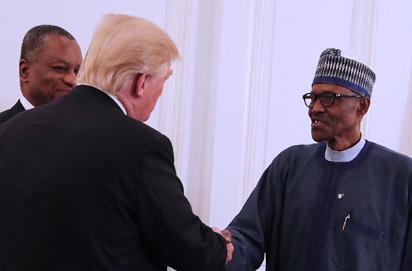
The group, in a statement by Mr Obed Monago, Chairman, NIDO Americas Board of Trustees and Mrs Patience Key, Chairman, NIDO USA Board of Directors, strongly condemned the statement allegedly made by the U.S. president.
The organisation stated that the preference of some immigrants because of the colour of their skin smacked of bigotry.
It also reminded the U.S. leader that in a country built with the laborious contributions of immigrants, aligning propriety and preference to Norway was clearly racist.
NIDOA said Nigerian immigrants were among the most educated, and contributed immensely to the greatness of the United States.
“Nigerians are proud to contribute to the betterment of the United States and will continue to do so.
“It is with enormous pain and outrage, that NIDOA condemns the deplorable, disgusting use of vulgarity to describe a broad set of people who, for the most part, have and continue to add value to the United States.
“We are not going to hold our breath for an apology, which would be proper for this insult on a well-meaning group of people.
“It is unfortunate that we have to voice our disdain and disgust, but we are left, for now, with no other option than this painful reaction.
“We wish the U.S. the very best in the days ahead. The United States needs to stay true to the founding of its democracy and the reason it should be a ‘light upon the hill’ for the world,” it said.
NIDOA stressed that such statement was beneath the dignity of the President of a country marked by the Statue of Liberty, honouring the Preamble to the Constitution and striving to attain a more perfect union.
“We painfully note the statement of Mr Trump that Nigerians will not go back to their ‘huts’ once they see the U.S. and ‘Haitians with AIDS;’ just to name a few,” the Nigerian organisation alleged.
It also noted what it said were Trump’s utterances over the years, including the ‘birtherism’ against former President Barack Obama and his disparaging announcement when he began his quest for the Presidency.
“We note the many immigrants who, as others, have bled and died for the U.S., an example being Emmanuel Mensah, who sacrificed himself for others just a few days ago in New York.
“This racist remark in no way, helps make America great. It does more to damage the cooperative and collaborative manner that other countries engage to help the U.S. in these trying times.
“In a democracy, as against a dictatorship, the checks on the system should rise to denounce, as the rest of the world has, the bigoted utterings from the Oval Office.
“The President should be the responsible leader of the free world, but the uninformed and bigoted statement of the President has caused the majority of the American people pain in more ways than one.”
NIDOA encouraged African countries, Haiti and others to be proud of their nationalities and stay true to their identities.
NAN
Trump would make 'big mistake' by leaving Iran deal: Moscow


US President Donald Trump speaks during a meeting with members of the House Committee on Ways and Means in the Roosevelt Room of the White House in Washington. / AFP PHOTO / SAUL LOEB
Russia on Saturday said Washington would be making a grave mistake by pulling out of the Iran nuclear deal, adding that Moscow would work hard to keep the landmark agreement alive.
Deputy Foreign Minister Sergei Ryabkov criticised remarks by US President Donald Trump, who on Friday said the US will not reimpose nuclear sanctions on Iran for the moment, but would withdraw later this year unless the terms of the deal are changed.
"We are gradually coming to the conclusion that an internal decision by the US to leave the (Joint Comprehensive Plan of Action) has already been made or is close to being made," Ryabkov said in an interview with Interfax news agency.
"This could be one of Washington's big foreign policy mistakes, a big miscalculation in American policy," he said.
Under the hard-won 2015 deal with Russia, the US, China, France, Britain, Germany and the EU, Iran agreed to curb its nuclear programme in exchange for lifting of a raft of international sanctions.
Trump on Friday gave an ultimatum to "either fix the deal's disastrous flaws, or the United States will withdraw."
America's allies see the accord as the best way to thwart Iran's nuclear ambitions and a victory for multilateral diplomacy. Tehran categorically denies it is seeking to develop atomic weapons.
But Trump argues that his predecessor Barack Obama gave away too much to Iran in sanctions relief, without forcing the Islamic republic to end its ballistic missile program and support for militant groups.
Ryabkov said Moscow must unite with Europe and China and undertake "intense work" to keep the existing plan intact and decried what he said was a US attempt to strongarm the situation.
"In what we heard yesterday, I don't see any invitation for Iran to enter dialogue," he said. "This defies the logic of the agreement.""Russia will do everything in its power to save the agreement," he said.
East-west clash as Czechs vote for new president


Czech President Milos Zeman/ AFP PHOTO / Radek Mica
Czech President Milos Zeman appeared Saturday to be heading for a run-off as voting began on day two of a presidential election pitting the pro-Russian incumbent against a flock of more liberal pro-European rivals.
Opinion surveys show the divisive 73-year-old ex-communist, who is also staunchly anti-Muslim and pro-Chinese, leading the pack of nine candidates ahead of Jiri Drahos, 68-year-old pro-European former head of the Czech Academy of Sciences.
Although Zeman is in pole position as the country kicks off a final day of first-round voting Saturday, the outspoken head of state is unlikely to win an outright majority, with a run-off expected on January 26-27.
As he voted in Prague on Friday, Zeman was targeted by a bare-breasted woman protester who called him "Putin's slut" in a move experts said might boost his chances judging by an outpouring of sympathy for him on social media.
Headlines like "Attack on Zeman" and "A scandalous incident" were splashed across the front pages of Czech daily newspapers on Saturday as voters headed to the ballot box for a second day.
The topless anti-Kremlin protester from Ukraine's Femen group was overpowered by bodyguards and then arrested by police.
Security personnel also had to help a visibly rattled Zeman, who walks with a cane, to leave the room.
Prague voter Martin Sauta said he chose Zeman as he has "the most consistent views", while his rivals are "completely shapeless".
But Prague wine bar owner Eva Simova, 53, told AFP that she was voting for Drahos: "He seems like an honest guy and what's more, I'm sick and tired of Zeman."
A recent poll for Czech Television showed Drahos winning a second-round vote with 48.5 percent support against 44 percent for Zeman.
A 'polarised' society
Zeman's rhetoric echoes populist-minded eastern EU leaders -- especially in Hungary and Poland -- at odds with Brussels over mandatory refugee quotas and various rules they see as attempts to limit national sovereignty.
He is also stridently anti-Muslim, having once called the 2015 migrant crisis "an organised invasion" of Europe and insisted Muslims were "impossible to integrate".
The country of 10.6 million people has received only 12 migrants under the EU quota system.
Drahos could not be more different. A mild-mannered liberal centrist whom critics have dubbed "wishy-washy", he has called for Prague to "play a more active role in the EU" and has backed the adoption of the euro currency.
After voting in Prague on Friday, Drahos said the future president "should work in the interest of the pro-Western orientation of the Czech Republic" in a clear dig at Zeman.
"The president should work to unite society. It's clear that not everyone can agree, but the current president doesn't unite people, he divides them," Drahos added.
Independent analyst Jiri Pehe said the vote highlights a "polarised" society.
"It is a clash between... the post-communist part of society represented by Zeman and the other part, say, modern, pro-Western, which simply doesn't want this president any more," he told AFP.
Unite or divide?
Zeman has the backing of embattled billionaire Prime Minister Andrej Babis, who said the incumbent "fights for our national interests" but called on him to "unite, not divide" Czechs.
Babis's populist ANO movement won last October's general elections with its anti-corruption and anti-euro campaign, but the Slovak-born tycoon who is facing police charges over EU funding fraud has failed to woo coalition partners.
Tapped by Zeman for prime minister in December, Babis was forced to form a minority government which appears set to lose a parliamentary confidence vote on January 16.
Pehe said a victory for Zeman might "pave the way for a deeper alliance with Andrej Babis, which could lead to a change in some basic parameters of liberal democracy in the country."
But the situation could change dramatically if Drahos wins.
"Drahos has made it very clear that a prosecuted man should not be prime minister," Pehe said.
Zeman's other rivals include ex-gambler and songwriter Michal Horacek, and former rightwing premier Mirek Topolanek.
The CTK news agency pegged turnout at 40 percent after day one of voting. Polling stations reopened at 0700 GMT and will close at 1300.
Soon after that, initial results will indicate which two candidates are likely to contest the expected run-off.
Trump denies 'shithole countries' remark


(FILES) This file photo taken on January 11, 2018 shows US President Donald Trump during a meeting on prison reform in the Roosevelt Room of the White House in Washington, DC. Outrage mounted on January 12, 2018 over US President Donald Trump's reported description of African nations, Haiti and El Salvador as "shithole" countries, with the United Nations slamming his comments as "racist". During a Thursday meeting with lawmakers on immigration reform, Trump demanded to know why the US should accept citizens from what he called "shithole" countries, according to comments first reported by the Washington Post./ AFP PHOTO / SAUL LOEB
US President Donald Trump tweeted a denial Friday after he was quoted as describing African and other states as "shithole countries," amid an international furor over the remarks.
Trump, who reportedly made the comment during a meeting with legislators Thursday on immigration reform, drew charges of racism.
"Why are we having all these people from shithole countries come here?" Trump said, people briefed on the meeting told The Washington Post.
The New York Times later reported the same comment, citing unnamed people with direct knowledge of the meeting.
"The language used by me at the DACA meeting was tough, but this was not the language used," Trump tweeted early Friday.
The reference was to the Deferred Action for Childhood Arrivals (DACA) program, which shields from deportation nearly 800,000 immigrants brought to the country illegally as children.
Thursday's meeting was to discuss a compromise under which DACA would be preserved but a visa lottery and a policy allowing legal immigrants to bring family members into the country would be ended.
"I want a merit based system of immigration and people who will help take our country to the next level," Trump said in another tweet.
Never said anything derogatory about Haitians other than Haiti is, obviously, a very poor and troubled country. Never said “take them out.” Made up by Dems. I have a wonderful relationship with Haitians. Probably should record future meetings - unfortunately, no trust!
— Donald J. Trump (@realDonaldTrump) January 12, 2018
"I want safety and security for our people," he added, criticizing the proposed bipartisan deal.
"USA would be forced to take large numbers of people from high crime countries which are doing badly," Trump tweeted.
The Post and the Times said Trump's vulgar remark Thursday was in reference to African countries and Haiti. The Post included El Salvador on its list.
Trump suggested the United States should instead welcome immigrants from places like Norway, whose prime minister met with Trump on Wednesday.
United Nations rights office spokesman Rupert Colville said "there is no other word one can use but 'racist'" to describe Trump's remarks.
Democratic congressman Luis Gutierrez called Trump "a racist who does not share the values enshrined in our Constitution."
Berlusconi throws flat tax plan into election campaign


Italian former Prime Minister and leader of center-right party Forza Italia (Go Italy), Silvio Berlusconi speaks on the set of the broadcast "Porta a Porta", a programme of Italian channel Rai 1, on January 11, 2018 in Rome. / AFP PHOTO / Alberto PIZZOLI
A promise of a flat tax by former prime minister Silvio Berlusconi Friday sparked sharp reactions from opponents ahead of a general election and head-scratching among economists.
Campaigning ahead of a general election on March 4 at the helm of the conservative Forza Italia movement, Berlusconi said on TV late Thursday that such a tax would start at the current minimum rate of 23 percent, before being brought down to below 20 percent.
The remarks by Berlusconi -- who never sought to introduce a flat tax during his three terms as prime minister -- immediately drew criticsm from centre-left former prime minister Matteo Renzi who said he wondered where the money to finance the move would come from.
"The flat tax at 15 percent would cost 95 billion euros ($115 billion), and at 20 percent 57 billion," Renzi said Friday.
A 15-percent flat tax proposal has been part of the platform of far-right Northern League, allied with Forza Italia, for years.
Its supporters says it would replace the current progressive tax rates which run up to 43 percent.
Forza Italia parliamentary chief Renato Brunetta called a flat tax "a revolutionary measure that will relaunch the country after the (current) disastrous government is gone".
Lost tax revenue would be offset by less tax evasion and higher spending power for households, supporters say.
"The crazy people who pay (taxes) now will pay a bit less, and those who don't pay at all will pay in the future," Northern League chief Matteo Salvini said.
But Luigi Marattin, an economist and former Renzi aide, called the flat tax "a colossal joke" and "deeply unfair" because it would benefit mostly the wealthy.
Capital Economics analyst Jack Allen, said imposing a flat tax "wouldn't be quite that simple", possibly violating the Italian constitution which calls for a progressive tax code.
He also said that any positive impact on economic growth "would be negligible" because the government would have to accompany the tax cuts with spending cuts "to avoid a blow-out in the budget deficit".
At any rate, Allen said, it was not certain that Italy's current tax regime is really a constraint on economic performance.
Instead, the government may be better advised to strengthen the business environment by making it easier to start a business, obtain credit and enforce contracts, he said.
Most Americans 'don't want' Oprah to run for president


Oprah Winfrey PHOTO:AFP
Americans may love Oprah Winfrey, but most don't want the chat show queen to run for president, although if she did she would beat Donald Trump, a poll revealed Friday.
Winfrey's rousing speech at Sunday's Golden Globe Awards ceremony ignited speculation that the billionaire entertainment mogul, the first black woman to own a television network, is harboring Oval Office ambitions.
Sixty-four percent of respondents have a favorable view of Winfrey, including 43 percent of Trump supporters, according to the NPR, PBS NewsHour and Marist survey.
But when asked if they wanted Winfrey to run in 2020, only 35 percent said yes. A majority -- 54 percent -- said no and 11 percent said they were unsure.
Yet if a hypothetical presidential head-to-head was held today, 50 percent of national registered voters said they would vote in Winfrey as a Democrat. Only 39 percent said they would return Trump to office.
Voters were predictably split along party lines. Ninety-one percent of Democrats backed Winfrey. Eighty-five percent of Republicans said they would vote for Trump.
While there is little indication that 63-year-old Winfrey wants the job, Hollywood's loathing of Trump and Democrats' bafflement that a reality TV star could win with no previous government experience has fueled talk of finding their own celebrity candidate.
Trump said Tuesday he doubted Winfrey would run, but if she did, he would win.
The survey was carried out among 1,350 adults earlier this week, after Oprah's speech made headlines. The poll carried a margin of error of 2.7 percent and three percent among registered voters.
Ex-Catalan leader's party pledges to re-elect him remotely


Catalonia's ousted regional president Carles Puigdemont (C) walks as he holds his first post-election meeting for members of his parliamentary group in Brussels on January 12, 2018. Spain's government will go to the country's Constitutional Court if Catalonia's former president Carles Puigdemont, in exile in Belgium, attempts to be re-elected into office from abroad, a government source said on January 11. Catalonia's separatist parties on December 21 retained their parliamentary majority with 70 seats in the 135-seat Catalan parliament, but eight belong to politicians who are either in jail or have fled to Belgium, after Madrid sacked the Catalan regional government following the October 1 referendum and the unilateral declaration of independence. / AFP PHOTO / JOHN THYS
The separatist party behind Catalonia's deposed president Carles Puigdemont said Friday it is determined to re-elect him remotely as the region's leader, even though he is in Belgian exile and Madrid has warned against such a move.
Puigdemont is the separatist camp's favoured candidate to lead Catalonia again after pro-independence parties won an absolute majority in December regional elections.
But he is in self-imposed exile in Belgium and risks arrest on charges of rebellion, sedition and misuse of public funds for his role in the region's failed independence bid if he comes back to Spain.
To be elected president, he should in theory be present at the parliamentary session where the vote takes place, but his supporters want him to appear by videolink or write a speech and have it read by someone else.
Asked about which option his party preferred, Elsa Artadi, Puigdemont's campaign manager, said they were "looking into all the tools that Catalan parliamentary rules allow."
In Brussels for a working meeting, she added that Puigdemont would not come back to Spain.
The Catalan parliament's rules stipulate that the candidate for the regional presidency must "present his or her government programme to parliament."
It does not detail whether this must be done in person, but several legal experts, the opposition and the central government insist it cannot be done remotely.
On Friday, central government spokesman Inigo Mendez de Vigo said Madrid would oppose such a move, adding that the candidate to Catalonia's presidency should be physically present.
"The government would take any such trick to court, without any hesitation," he added.
Catalonia's Socialist party has asked judicial experts at the regional parliament whether appearing by videolink or via a written speech would be legal.
According to the Catalan daily La Vanguardia, "there is total unanimity" among these experts that his physical presence is required.
Artadi said it would be up to the next parliamentary speaker or lawmakers as a whole to interpret the rules.
It is still unclear however whether some separatist lawmakers will be able to vote, given some are in Belgium with Puigdemont and others in jail pending a probe into their role in the independence drive.
On Friday, the Supreme Court refused to allow the three jailed lawmakers -- including former Catalan vice president Oriol Junqueras -- out to attend the first parliamentary session on January 17.
But he has allowed them to pass their vote on to someone else.
Poll: Majority of Germans see Merkel gone by 2021 elections

According to the poll conducted by the Infratest institute and published by the business daily Handelsblatt, on Thursday, 56 per cent see Merkel departing early, should she be re-elected Chancellor by the Bundestag.
Merkel’s Christian Democrats (CDU), along with their long-term allies, the Bavarian Christian Social Union (CSU), are engaged in talks with the Social Democrats (SPD) to revive the coalition following the September elections, even though all three parties lost ground.
According to the report, 23 per cent of those polled in early January were critical of what they saw as indecisiveness on the part of the 63-year-old leader, who has been chancellor since 2005 and is currently serving in a caretaker capacity.
Merkel stands accused by many of those polled of sitting out problems rather than confronting them, but 20 per cent saw her calmness and composure as Merkel’s greatest asset.
Asked about possible successors to the CDU leader, 37 per cent put Interior Minister, Thomas de Maiziere in the lead, followed by Peter Altmaier, who heads the chancellor’s office, on 31 per cent.
The representative telephone poll of 1,012 eligible voters put Defence Minister, Ursula Leyen in third place on 28 per cent, and the Prime Minister of the western state of Saarland, Annegret Kramp-Karrenbauer, in fourth on 24 per cent. (NAN)
INEC registers 21 new parties


The News Agency of Nigeria (NAN) recalls that the registration of the 21 new political parties was approved by the commission on Dec. 14, 2017, bringing the number of registered parties in the country to 68.
The political parties are All Blending Party (ABP), All Grassroots Alliance (AGA), Alliance for New Nigeria (ANN), Abundant Nigeria Renewal Party (ANRP), Coalition for Change (C4C) and Freedom and Justice Party (FJP).
Also registered are Grassroots Development Party of Nigeria (GDPN), Justice Must Prevail Party (JMPP), Legacy Party of Nigeria (LPN), Mass Action Joint Alliance (MAJA), Modern Democratic Party (MDP), National Interest Party (NIP), National Rescue Mission (NRM) and New Progressive Mission (NPM).
New Progressive Movement (NPM), Nigeria Democratic Congress Party (NDCP), People’s Alliance for National Development and Liberty (PANDEL), People’s Trust (PT) and Providence People’s Congress (PPC) were also registered.
Also on the list are Re-Build Nigeria Party (RBNP), Restoration Party of Nigeria (RP) and Sustainable National Party (SNP).
The INEC Chairman, Prof. Mahmood Yakubu, said at the certificates presentation ceremony new parties said that compliance with the judgment of the Federal High Court, the Commission had also registered the Socialist Party of Nigeria (SPN).
“We have already issued the Certificate of Registration to the SPN.
“The number of new political parties has risen to 22 in addition to the 46 parties already in existence. This means that the total number of political parties in Nigeria today stands at 68,’’ he said.
Yakubu advised the new parties to operate within the law at all times, as well add value to our democracy by adhering to the tenets of democratic norms anchored on the rule of law.
“Your registration is coming close to the 2019 general elections for which the commission has released the timetable and schedule of activities.
“Later this year, two Governorship elections are scheduled in Ekiti State on July 14 and Osun State on Sept. 22.
“It is of utmost importance for political parties ensure that their respective activities are not only open and democratic but also based on compliance with relevant provisions of your respective Constitutions,’’ said the chairman.
Yakubu disclosed that since the registration of the 21 new political parties, the commission had received more 90 applications from associations seeking registration as political parties.
He said that out of the 90 applications, 61 associations had failed the initial assessment of their proposed names, logos or acronyms and had been notified.
“Twenty five associations that passed initial assessment have been advised to proceed to the next stage of the registration process.
“Four associations are undergoing preliminary assessments of the suitability of their proposed names, logos and acronyms.’’
He assured all associations that the commission would continue to treat each application fairly and on its merit consistent with the provisions of the law.
Yakubu also assured Nigerians that INEC was capable of managing the increased numbers of registered political parties in the country.
“The number of political parties is good for our plural democracy. However, political parties must cooperate with the Commission for successful elections.
“If each of the 68 political parties in Nigeria today fields candidates for all the 1,558 constituencies to be contested in the 2019 general elections, the commission will grapple with 105,944 candidates.
“If you consider the management and logistics of providing ballot papers for a projected 80 million registered voters, ad hoc staff.
“The requirements for forward and reverse logistics, monitoring of political party primaries, electioneering campaign, campaign finance, voter education, accreditation of national/intenational observers and the media, the task is enormous.
“I wish to assure Nigerians that we are aware of the challenges. We are also up to the task,’’ Mahmood said.
He appealed to political parties to adhere strictly to the 2019 election timelines warning that INEC would not hesitate to reject the submission by any party that violates the timelines.
The Chairman of Inter-Party Advisory Council (IPAC), Alhaji Mohammed Nalado, commended INEC for registration of the new parties, while advising the new parties to play by the rule.
Responding on behalf of the newly registered parties, the National Chairman of JPF, Breakforth Onwunbuya, also commended INEC for approving their registration.
Onwunbuya pledged that the new parties would contribute their quotas towards deepening of Nigerian democracy and improving the country.
Popular Posts
-
 The Nigerian Navy Direct Short Service Commission (DSSC) 25 Course has released list of its successful candidates who passed the Aptitude...
 -
 Outrage over six dead appointees on Buhari’s board list Niyi Odebode, John Alechenu, Olalekan Adetayo, Adelani Adepegba, Ade Adesomoju,...
 -
This file photo taken on August 31, 2006 shows a permanent memorial to Diana, Princess of Wales and Dodi al-Fayed is seen in Harrods ...
-
 Coalition holds #EndSARS rallies nationwide today A coalition of civil society groups will on Monday (today) hold rallies nationw...
 -
 Ex-Ivorian Star Emmanuel Eboue Is Dead The former Ivorian International star, Emmanuel Eboue, is dead. Emmanuel Eboue is reported to ha...

Popular Posts
-
 WAEC Extends Private Candidates Registration Till January The West African Examination Council (WAEC) has extended the closing date f...
 -
 Scientists have warned that the more Viagra-type drugs men take, the lower their sexual confidence becomes. This warning was contained ...
 -
 SEOUL, South Korea – The Latest on tensions over North Korea's nuclear and missile programs (all times local): 9 p.m. NATO's...
 -
Russian Foreign Minister Sergei Lavrov has accused the US of seeking to provoke North Korea into stepping up its nuclear missile program...
-
The ‘fraud’ called new year resolution “SUCCESS isn’t owned; it’s leased, and the rent is due every day”-J. J. WattPaula White once sa...


